
 English
 中文简体
 русский
Company News
Home / News / Company News / Medical Nonwoven Fabric: The Invisible Barrier Powering Modern Healthcare


Medical Nonwoven Fabric: The Invisible Barrier Powering Modern Healthcare
Every day, in operating rooms, isolation wards, and emergency departments, a quiet revolution is taking place. It is not a new drug or a robotic surgeon, but a material that makes modern infection control possible: medical nonwoven fabric. From the surgical gown a doctor wears to the mask on a nurse’s face and the drape covering a patient, nonwoven fabrics form a critical line of defense against pathogens, fluids, and cross-contamination. For healthcare procurement teams, distributors, and independent brands, understanding this material is not just a technical necessity—it is a commercial opportunity in a market that continues to expand at a remarkable pace.
The global medical nonwoven market has demonstrated strong and consistent growth, expanding from $11.49 billion in 2025 to an estimated $12.31 billion in 2026, at a compound annual growth rate (CAGR) of 7.1%. Looking further ahead, the market is projected to reach $16.32 billion by 2030**, driven by an aging global population, rising surgical volumes, and increasingly stringent infection control regulations. The disposable medical nonwoven segment alone was valued at **$14.6 billion in 2025 and is expected to reach $26.0 billion by 2034, reflecting a CAGR of 6.45%. These figures tell a clear story: demand for high-performance nonwoven medical barriers is not a temporary spike—it is a structural shift in how healthcare systems protect patients and staff.
The protective magic of medical nonwovens lies in their layered engineering. The most widely used architecture in medical apparel and drapes is SMS (Spunbond–Meltblown–Spunbond), a three-layer composite. The two outer spunbond layers provide structural strength, softness, and resistance to tearing. The inner meltblown layer, composed of microfibers roughly one-tenth the diameter of a human hair, acts as the primary filtration barrier. This meltblown core traps bacteria, fluids, and particulate matter while still allowing the fabric to breathe.
For higher-risk applications, SMMS (Spunbond–Meltblown–Meltblown–Spunbond) adds a second meltblown filtration layer. This is not merely a matter of extra thickness. A single meltblown layer can contain microscopic “thin spots” or pinholes created during manufacturing; the second layer covers those weak points, creating a redundant safety system that significantly reduces the statistical probability of barrier failure. SMMS fabrics are preferred for high-filtration surgical masks, N95-style respirators, and high-risk surgical environments where consistent barrier performance is non-negotiable.
Antibacterial protection in medical nonwovens is achieved through two complementary mechanisms. The physical barrier itself blocks bacterial penetration—advanced materials demonstrate bacterial penetration resistance of ≥99.9% and high liquid repellency with contact angles of ≥120°. Beyond physical blocking, functional treatments such as silver-ion coatings actively attack the negatively charged cell walls of bacteria, causing cell lysis and delivering durable antimicrobial activity. These materials are engineered to meet EN 13795 standards for surgical masks, gowns, and clothing.
Waterproof performance is quantified through hydrostatic head testing, which measures the water pressure a fabric can withstand before leakage occurs. Medical SMS fabrics typically deliver hydrostatic head values in the range of 35 to 150 cm H₂O, with higher-grade composites achieving even greater resistance. This waterproofness is paired with breathability: the microporous structure of the meltblown layer allows moisture vapor to escape while blocking liquid water, keeping clinicians comfortable during prolonged wear. Synthetic blood penetration tests require resistance at pressures of ≥3.5 kPa, and hydrostatic resistance must reach ≥17 cmH₂O under standardized testing protocols.
Isolation capability is the cumulative result of these properties. Nonwoven isolation gowns and drapes must prevent the transfer of blood, body fluids, and pathogens from patient to clinician and vice versa. The performance benchmark is defined by frameworks such as ANSI/AAMI PB70 and EN 13795, which classify barrier protection into levels based on the clinical risk of fluid exposure. For example, a Level 1 gown, suited for routine patient care, can be made from single-layer spunbond polypropylene. A Level 2 gown for blood draws and suturing typically uses SMS fabric in the 25–30 gsm range, while a Level 3 gown for emergency rooms and ICUs requires SMS or SMMS fabric in the 35–45 gsm range. Level 4 protection, intended for pathogen and viral defense, demands PE-coated laminates or specialized composites capable of passing ASTM F1671 with zero viral penetration.
Surgical gowns represent the most demanding application. They must balance barrier performance, breathability, tear resistance, and drapability. AAMI Level 3 gowns are tested for hydrostatic pressure and must withstand moderate fluid exposure scenarios such as arterial blood draws and trauma cases. SMMS constructions are frequently specified for these critical environments because the double meltblown core delivers superior filtration without adding unnecessary weight.
Medical face masks rely on nonwoven filtration for their protective effect. A standard three-ply surgical mask uses SMS construction: the outer spunbond layer repels droplets, the meltblown core filters bacteria and particles, and the inner spunbond layer provides comfort against the skin. Performance is measured by Bacterial Filtration Efficiency (BFE) and Particle Filtration Efficiency (PFE) . Under EN 14683 and ASTM F2100 standards, high-quality medical masks achieve BFE of ≥98% and PFE of ≥95% at 0.1 microns.
Medical bed sheets and surgical drapes demand a different balance of properties. They must resist liquid strike-through while remaining soft, quiet, and drapable for patient comfort. SMS nonwoven fabrics are widely used for disposable bed sheets, pillow covers, and drapes, often with PE film lamination for enhanced waterproofing in high-risk settings. The fabric’s high tensile strength and dimensional stability ensure it maintains integrity during patient repositioning and surgical procedures.
Isolation gowns serve as the everyday shield in infection control. Unlike surgical gowns, which are tested for specific fluid pressures during procedures, isolation gowns must provide a reliable barrier during routine patient contact, visitation, and ward activities. SMS nonwoven fabric in the 25–30 gsm range meets AAMI Level 2 requirements and is the material of choice for isolation gowns that must be both protective and cost-effective. For facilities managing suspected or confirmed infectious cases, higher-level isolation gowns using SMMS or coated laminates provide an additional margin of safety.
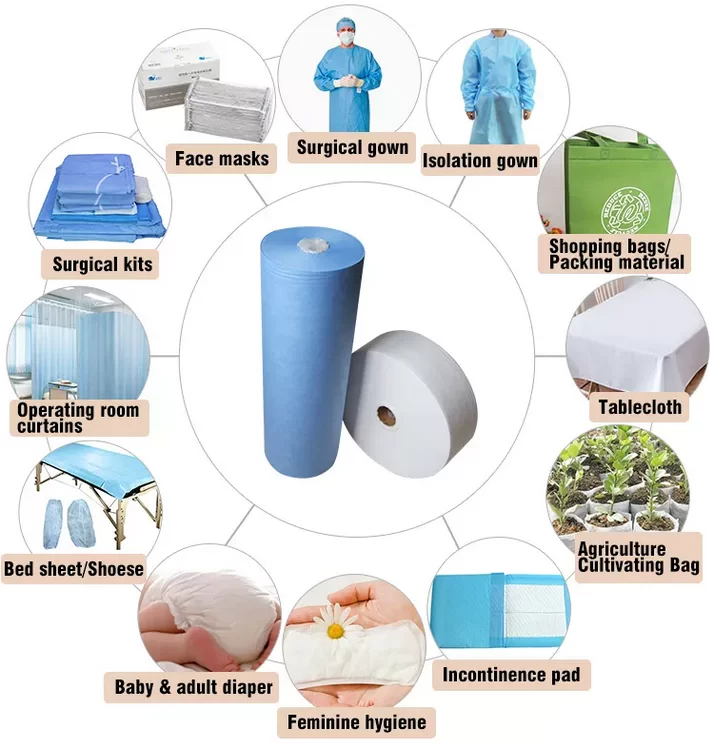
The shift from reusable woven textiles to disposable nonwoven medical products is driven by hard economics and harder science. Woven fabrics require laundering, sterilization, inspection, and logistics—each step adding cost and introducing opportunities for contamination. Nonwoven disposables eliminate cross-contamination risks, reduce labor and utility expenses, and deliver consistent, verifiable barrier performance batch after batch. The meltblown core traps microscopic bacteria and fluids with a level of reliability that traditional woven pores simply cannot match. As hospital-acquired infections remain a persistent challenge—California alone recorded over 8,000 HAI cases in 2023—the demand for dependable single-use barriers will only intensify.
For sourcing professionals and brand owners, the medical nonwoven category offers a rare combination: essential demand, regulatory tailwinds, and continuous material innovation. Whether the requirement is a basic Level 1 isolation gown or a Level 4 viral-barrier surgical ensemble, the performance is built into the fabric. The question is no longer whether to adopt nonwoven protection—it is which specification matches the risk, and which supply partner can deliver it with consistency and compliance.
The barrier is invisible. The protection is not.

Add : No. 88,Pingzhang Road,Linhang Industrial Region,Deqing county 313219, Zhejiang, China
Copyright © Zhejiang Huachen Nonwovens Co., Ltd. All Rights Reserved.
Wholesale Spunbond Nonwoven Fabric Manufacturers

The information provided on this website is intended for use only in countries and jurisdictions outside of the People's Republic of China.